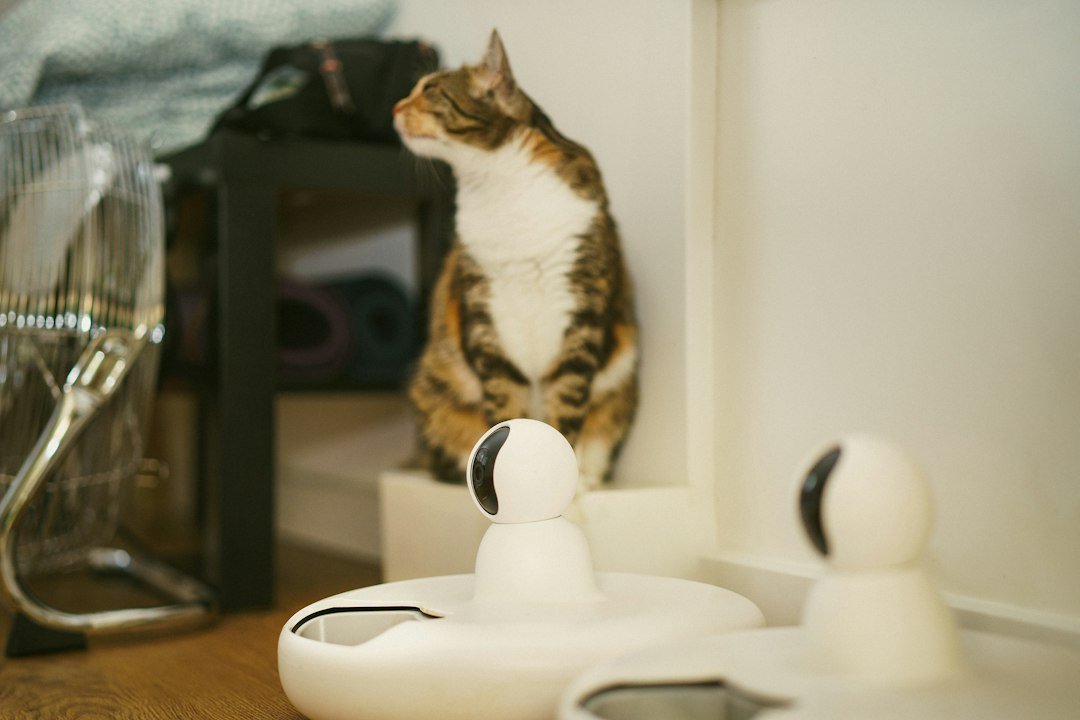
For the usual puzzle feeder vs slow feeder bowl decision, put your cat’s next measured meal in a simple puzzle feeder and watch the first five minutes closely. Start with one meal. A puzzle feeder is the better pick for most healthy adult cats that rush through dry food, because it makes eating take longer while giving them something purposeful to do. The puzzle feeder vs slow feeder bowl choice changes when a cat becomes upset, gives up on the food, has trouble using their mouth or paws, or eats wet food that does not work well in a particular puzzle.
How puzzle feeders and slow feeder bowls work
A puzzle feeder makes a cat move food out of a device before eating it. The cat may bat a rolling feeder, reach into a cup or tray, or use a paw to pull kibble through an opening. It adds effort. That extra step can spread a meal over a longer period, especially for cats that normally finish a bowl of kibble in a minute or two.
A slow feeder bowl keeps food in one place but puts ridges, channels, or raised shapes in the way. Your cat eats around those barriers instead of taking large mouthfuls from an open dish. It is less complicated. Most cats understand the bowl immediately, which is useful when the goal is simply to make a fast eater pause without asking them to learn a new feeding routine.
Neither product has one fixed eating time. A determined cat can empty a shallow puzzle quickly, while another cat may take several sessions to work through the same amount of kibble. Shape matters. So does the food size, the cat’s appetite, and whether the feeder slides across the floor.
Puzzle feeder vs slow feeder bowl for most fast eaters
Choose a puzzle feeder first if your cat is physically comfortable, food-motivated, and willing to investigate new objects. This is the clearest recommendation for the common case. It usually gives you more control over difficulty than a slow feeder bowl, and it can turn part of an indoor cat’s meal into an activity rather than a quick stop at the dish.
Begin easy. Use a feeder with wide openings, a simple rolling chamber, or a shallow puzzle tray where the kibble is visible. A cat that gets food within a few tries is more likely to keep working. If the first version is too hard, your cat may walk away and then return later feeling hungrier and more frustrated.
Do not make every meal difficult on day one. Put roughly one-quarter to one-half of the usual dry-food portion in the puzzle feeder, then offer the rest in the normal bowl or in a very easy feeder. For example, if your cat normally gets 1/2 cup of kibble across the day, start with about 2 tablespoons in the puzzle and keep the remaining food easy to access.
When a slow feeder bowl wins
A slow feeder bowl is the better option when your cat needs less challenge and more certainty. Keep it simple. This often includes cats that ignore puzzle toys, become vocal or agitated around difficult food tasks, or have never shown interest in batting and pawing at objects for treats.
It can also be a more practical choice for wet food. Many puzzle feeders are designed around dry kibble and become messy when filled with pâté, gravy, or moist chunks. A shallow slow feeder bowl made for wet food can spread a portion into grooves, which may slow the meal without leaving food hidden in a device that is hard to wash.
Use extra care with cats that have sore mouths, missing teeth, reduced mobility, poor vision, or any change in their normal eating habits. Frustration is a clue. A simple bowl with low, rounded barriers may be easier than a feeder that requires precise paw work, but a new struggle with eating is a reason to speak with a veterinarian rather than keep increasing the difficulty.
Slow feeder bowls also win for households where the person feeding the cat needs a quick, repeatable routine. Fill the bowl, set it down, and wash it after the meal. That convenience matters when several people share feeding duties or when a cat sitter will be handling meals.
Pick the right level of challenge
The best feeder is one your cat can solve calmly. Watch closely. A good starting level makes your cat pause, sniff, and work at the food while still getting regular small rewards. They should not need to spend long stretches staring at the feeder with no success.
Look for these signs that the feeder is too easy: your cat clears it nearly as fast as an ordinary bowl, flips it over, or learns to dump all the food out at once. In that case, choose a heavier model, reduce the opening size if the product allows it, or use a design with a less direct path to the kibble.
Look for different signs that it is too hard: repeated pawing with no food coming out, biting or dragging the feeder, walking away before eating enough, or appearing unusually tense around mealtime. Stop and simplify. A feeder should slow a meal, not turn food access into a daily battle.
Personality matters more than breed labels. One bold cat may enjoy a rolling feeder immediately, while another prefers a stationary tray where the food stays visible. If you have more than one cat, give each cat their own feeding spot and feeder, because a confident cat can take over a puzzle while the other cat waits.
Set up a puzzle feeder without causing frustration
- Measure the meal first. Keep the total daily amount the same unless a veterinarian has advised a different plan. Extra kibble used for “practice” still counts as food.
- Start with dry food your cat already eats. Familiar smell helps. Avoid introducing a new diet and a new feeder in the same meal if you want to know what your cat dislikes.
- Make the first puzzle easy. Use the largest opening or the least complicated setting, and place a few pieces where your cat can see them.
- Put it on a stable surface. A nonslip mat can keep a rolling feeder from disappearing under furniture and can make cleanup easier.
- Time the meal once or twice. If a meal that took 45 seconds now takes five to 10 calm minutes, that is a useful change for many fast eaters.
- Adjust one thing at a time. Change the amount, opening, or puzzle type on separate days so you can see what actually helps.
If your cat eats canned food, try a shallow slow feeder bowl or a lick mat made for food, provided it is easy to clean and your cat can reach the food comfortably. Keep portions modest. Thick wet food can be pressed lightly into broad grooves, but avoid packing it so firmly that your cat has to scrape hard to eat.
Cleaning, safety, and everyday use
Wash food feeders after use, especially when they hold wet food. Food residue hides in seams. Check rolling feeders for loose caps, cracked plastic, or parts small enough to become a hazard if chewed, and remove damaged products rather than trying to keep them in service.
Choose a size that suits the meal. A huge puzzle filled with a tiny portion can make food difficult to find, while a very small feeder may jam if the kibble pieces are large. Read the product instructions before use. Prices vary by region, and materials and replacement-part availability can differ a lot between models.
Keep an ordinary bowl available during the learning period if your cat is hesitant. This is temporary. Once the feeder is clearly working well, you can decide whether to use it for one meal each day or for most dry-food meals.
Frequently asked questions
Which slows eating better, a puzzle feeder or slow feeder bowl?
A puzzle feeder usually slows eating better because food comes out in small amounts and requires active work. That is the usual result. A slow feeder bowl may be enough for a cat that only needs a modest pause, especially if the cat finds puzzles irritating or refuses to engage with them.
Can I use a puzzle feeder for every meal?
Some cats do well with most or all dry-food meals in an easy puzzle feeder. Start gradually. Keep the difficulty low enough that your cat reliably finishes an appropriate amount, and offer a simpler option if they are still learning or if you will be away longer than usual.
Are slow feeder bowls good for wet cat food?
They can be, as long as the bowl has broad, low channels that you can clean fully. Shallow works best. Avoid deep, narrow grooves that trap food or make your cat work their face awkwardly around high barriers.
What if my cat flips the puzzle feeder over?
Try a heavier stationary puzzle, a feeder with a nonslip base, or place the feeder inside a low-sided tray that limits travel. Do not punish the flipping. Your cat has found the easiest route to the food, which means the feeder design is not a good match for that cat.
Should I use a feeder if my cat suddenly starts eating too fast?
A feeder may help manage the pace of a normal meal, but sudden changes in appetite or eating behavior deserve attention. Do not ignore it. Contact a veterinarian if the change continues, if your cat seems uncomfortable, or if you notice other changes in drinking, litter box habits, energy, or weight.
Related posts
This post is for general informational purposes only and is not veterinary advice. Every cat is different — if you have concerns about your cat’s health or behavior, please consult a qualified veterinarian.