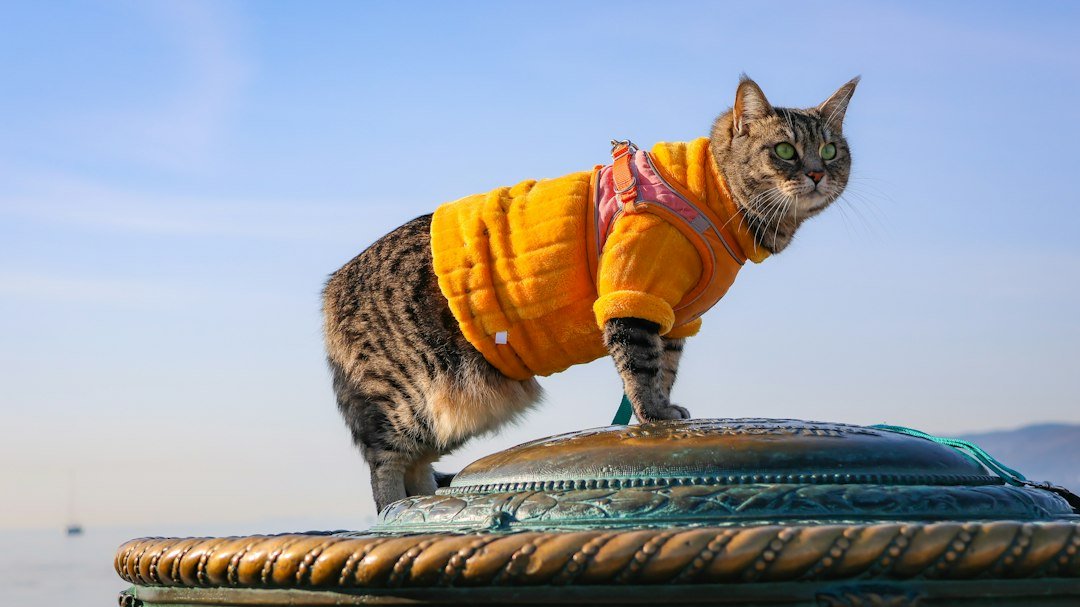
The best cat life jacket for boating is a snug, lightweight flotation vest that stays put when your cat twists, has a strong top handle, and does not interfere with breathing or walking. Fit comes first. Even a well-made vest is a poor choice if your cat can back out of it, if the neck opening presses on the throat, or if the chest panel limits shoulder movement. For most cats, a purpose-made pet flotation device with adjustable straps is a more practical option than adapting a human buoyancy aid or relying on a regular harness.
Cats and boats are not always an easy pairing. Some cats settle quietly in a carrier below cover, while others find engine noise, waves, unfamiliar smells, and open water deeply stressful. A life jacket can help keep a cat afloat during an unexpected fall overboard, but it does not prevent panic, exhaustion, cold exposure, or escape. Keep expectations realistic. The safest plan usually includes a secure carrier or enclosed cabin area, close supervision, and a jacket that has been tested well before departure.
How to choose the best cat life jacket for boating
Look at the jacket as a restraint-and-recovery item as much as a flotation item. The key question is whether it will remain correctly positioned if your cat squirms, turns sharply, or is lifted from the water. Read current product descriptions, buyer photos, and manufacturer sizing instructions as research, then compare them against your own cat’s measurements rather than choosing by breed or a vague small, medium, or large label. Labels vary.
A useful jacket has enough buoyant material around the torso to support the body, while keeping bulk away from the front legs and underarms. Many pet flotation vests use foam panels along the back and sides, with a chest piece that helps keep the body oriented in water. A bright outer color can make a cat easier to spot. Reflective trim may help in low light, although it is no substitute for a light, careful supervision, and a fast response.
The recovery handle deserves close inspection. It should be firmly sewn into the jacket body, sit near the center of the back, and feel substantial enough to lift your cat briefly without twisting the vest sideways. Test it indoors. Hold the handle gently with one hand while supporting your cat’s chest and hindquarters with the other, and watch whether the jacket shifts toward the neck or pulls at the armpits.
| What to check | Why it matters on a boat | What a good fit looks like |
|---|---|---|
| Neck opening | A loose opening can allow escape; a tight one may cause pressure and discomfort. | You can slide one or two fingers under it without forcing them. |
| Chest and belly straps | These keep the vest from rotating if the cat struggles or is lifted. | Straps lie flat and stay behind the front legs without rubbing. |
| Buoyancy panels | Foam helps support the body after an accidental fall into water. | Panels cover the torso without blocking normal leg movement. |
| Top handle | A handle helps you recover a cat quickly at the boat edge. | It is centered, reinforced, and does not distort the jacket when lifted. |
| Closures and stitching | Saltwater, wet fur, and movement can expose weak fastenings quickly. | Closures fully engage and stitching looks even with no loose threads. |
Start with sizing, not the weight label
A sizing guide is more useful than a weight range, because cats with the same weight can have very different chests, body lengths, and shoulder shapes. Measure your cat while they are standing naturally on a non-slip surface. Keep it calm. A soft tape measure is easiest, but a piece of string followed by a ruler also works.
- Measure the neck where the jacket collar will sit, usually low on the neck rather than directly under the jaw.
- Measure the widest part of the chest, commonly just behind the front legs.
- Measure the back length from the base of the neck to the base of the tail if the manufacturer requests it.
- Weigh your cat if possible, then use weight only as a secondary check against the maker’s chart.
- Compare each measurement with the listed range and size up only when the chart specifically advises it.
Write the measurements down before shopping. If your cat’s chest falls near the top end of one size and the neck falls near the bottom end of the next, prioritize the brand whose chart accommodates both measurements without relying on fully tightened or fully loosened straps. A jacket that only fits at the extreme end of every adjustment range leaves little room for a secure final fit.
Once the vest arrives, fit it indoors while your cat is relaxed. Begin with a minute or two, offer a familiar treat if that suits your cat, and remove the jacket before frustration builds. Short sessions help. A cat that freezes, rolls, walks backward, or tries persistently to chew the straps may need a slower introduction, a different cut, or may simply not be comfortable with boating.
Check movement and escape risk
Do a practical fit check before taking the jacket near water. With the vest fastened, your cat should be able to take several normal steps, sit, turn their head, and lie down without the fabric bunching at the front legs. Watch the shoulders. If the vest rides forward every time the cat walks, it is likely too loose at the chest or poorly shaped for that individual body.
Then check for escape routes. Gently place two fingers beneath the neck and body straps, and lightly tug the back of the vest in the direction a cat might pull when reversing out of it. Do not yank. If the jacket slides over the shoulders, rotates dramatically, or exposes a gap big enough for a paw to work through, adjust it or choose another model.
Do not attach a leash to the life jacket handle unless the manufacturer specifically states that it is designed as a leash attachment point. Handles are generally made for short recovery lifts, not continuous pulling against a tether. Use a separate, well-fitted harness for controlled handling on land or in a secure marina area, and avoid leaving a tethered cat unattended on deck.
Material and design trade-offs
More foam can mean more flotation, but it can also make a small cat feel stiff and overheated on a warm day. Less bulk may be easier to tolerate, yet it may offer less support in water. There is no perfect design. The best balance depends on your cat’s size, comfort, the water temperature, and whether the boat has a protected indoor space.
Mesh sections can improve ventilation and reduce drying time, while padded panels may feel softer against the body. Check where wet material will touch the underarms and belly. Rough edges matter. A jacket may look comfortable in a product photo but rub after several minutes of walking, especially if the cat’s coat becomes damp.
Bright colors are sensible for visibility, though some cats react to crinkly trim, bulky collars, or stiff foam near the ears. A front flotation pad may help orientation in water, but it can also limit head movement on a short-necked or compact cat. Try the vest on indoors before removing tags, if the seller’s return policy allows. Policies differ, so verify the current terms before purchase.
Plan for the boat, not only the water
A cat wearing a life jacket can still slip through rail gaps, jump toward birds, or hide in an unsafe part of the boat. Decks get slippery. Before leaving the dock, identify one enclosed resting area where your cat can travel in a secured carrier or protected cabin space, away from lines, open hatches, hot engine areas, and people moving gear.
For a short outing, bring fresh water, a familiar towel, a carrier, and a way to manage toileting if the trip runs longer than expected. Keep the jacket accessible even if your cat does not wear it continuously below deck. If the boat is moving or your cat will be on an open deck, the vest should already be fitted correctly rather than stored loose in a bag.
Practice the recovery plan with another adult before bringing the cat aboard. One person can control the boat while the other retrieves the cat using the handle and full body support, then places them immediately into the safe enclosed area. Move calmly. Trying to improvise during a real fall can waste valuable seconds and increase stress for everyone.
When a life jacket is not enough
A flotation vest is not a substitute for deciding whether your cat should join the trip at all. If your cat becomes highly distressed in a carrier, pants, vocalizes continuously, lashes out, or cannot settle during brief stationary boat visits, a quiet home setup with a trusted sitter may be the kinder option. Some cats prefer land. That is completely normal.
Also avoid assuming that a cat can swim safely because they can paddle in a bathtub or have tolerated shallow water. Open water adds cold, currents, wave action, difficult boat sides, and disorientation. Even strong swimmers can tire quickly. A properly fitted jacket improves your ability to recover a cat, but prevention remains the most useful safety measure.
Frequently asked questions
Should a cat wear a life jacket the whole time on a boat?
It depends on where the cat is and how secure that area is. If your cat is in a closed carrier or enclosed cabin, continuous wear may be unnecessary and uncomfortable, especially in warm weather. Keep it nearby. On an open deck, during docking, or whenever there is a realistic chance of falling overboard, a fitted life jacket is the safer choice.
How tight should a cat life jacket be?
The vest should be snug enough that it does not slide over the shoulders or rotate around the torso, but loose enough to allow normal breathing and movement. Two fingers under a strap is a common starting check. Watch your cat walk. If the straps dig into the underarms, the chest panel presses against the throat, or the cat cannot take normal steps, refit or replace it.
Can I use a small dog life jacket for my cat?
Sometimes, but only if the measurements and cut suit your cat. Dog jackets often have broader chests, longer backs, or strap placements that work poorly on a cat’s narrower body and flexible shoulders. Check the fit carefully. A cat-specific design may offer a better shape, but the individual fit still matters more than the product label.
What should I do if my cat hates the jacket?
Slow the process down and use brief indoor sessions rather than putting the jacket on for the first time at the dock. Let your cat inspect it, fit it loosely for a minute, and end the session calmly. If repeated practice causes clear distress or the vest cannot be adjusted without restricting movement, boating may not be a suitable activity for that cat.
Related posts
This post is for general informational purposes only and is not veterinary advice. Every cat is different — if you have concerns about your cat’s health or behavior, please consult a qualified veterinarian.